
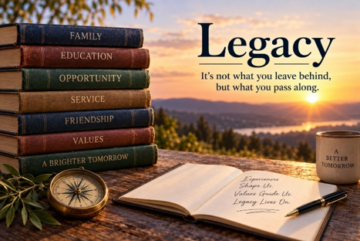
 “What do I hope to leave behind?”
That’s the question posed by Donna Lipman at the end of a recent Substack post. Donna is one of my favorite bloggers and someone I’ve been privileged to meet. If you’re not following Donna, you should. In her blog, Donna shared a video interview with Brittany Howard about her thoughts on death and dying. In the interview, Howard offered her view of the afterlife, describing it as “a place of peace.” Donna’s post, the death of Dolly Parton, the subsequent media stories about Dolly’s legacy, Brittany’s label for the afterlife, and perhaps, inevitably, my own aging process inspired me first to comment on Donna’s post and then to think more deeply about her question. My comment responding to her question eventually became the foundation for this blog.
As I get older, I think less about being remembered for what I accomplished and more about whether my life made a difference in the lives of others. Titles disappear. Jobs end. Organizations change. Awards gather dust. Even our names eventually fade from memory. I hope I leave behind some ideas that mattered, some organizations that are better because I was part of them, some people whose careers or lives were made a little better because our paths crossed, and perhaps a few examples of kindness, integrity, curiosity, and service that others thought worth carrying forward.
Of course, whatever legacy I leave did not begin with me. I am the beneficiary of generations that came before me. My father was born in Austria to Polish parents, and my mother was born in Mississippi, also to Polish parents. Her early life took an unusual turn when a devastating flood made it impossible for her birth parents to care for both her and her older brother. She was given to an aunt and uncle to raise, which meant that I had the extraordinary privilege of growing up with three sets of grandparents. Even more remarkable was the warmth and love among all of them. I never thought of one set as somehow more “real” than another. They were simply my grandparents.
All six became American citizens, and I have never known more enthusiastic patriots. None had the opportunity to attend junior high or high school in the countries from which they came, yet reading, learning, and education were enormously important to them. They took remarkable pride in seeing their children and grandchildren graduate from college, and even greater pride as many went on to earn advanced degrees. They understood the value of opportunities they themselves had never been given.
Looking back, I suspect they were also the source of gratitude that has traveled through our family. They were grateful for their families, grateful for opportunity, grateful for education, and deeply grateful for the country they had chosen as their own. That gratitude was passed down to their children and, I believe, to the generations that followed. It reminds me that legacy is not simply what we leave behind. It is also what we inherit, what we choose to preserve, and what we pass along.
That inheritance was reinforced by my siblings, cousins, and the families they created. I have been extraordinarily fortunate that so many of these relatives have also been among my closest and most enduring friends. I learned from watching the lives they built, the relationships they nurtured, the challenges they faced, and the ways they contributed to their own communities. They were and continue to be models for me, often without knowing it.
Their spouses and children expanded that circle and brought their own experiences, values, traditions, talents, and perspectives into our family. In that sense, what was passed down to us did not simply move from one generation to the next. It spread outward as each of us formed families, friendships, careers, and communities of our own.
So, to my siblings, my cousins, and the families they created I say, “Thank you.” You have been part of shaping who I am, just as I hope I have contributed in some small way to your lives. Perhaps that is another lesson about legacy. We don’t create it alone, and we don’t pass it forward alone. We create it in relationship with one another.
And then there are my friends. Eight of us still get together two or three times a year, and when we do, we can talk for days and often do. We also meet by Zoom every month, maintaining friendships that, in some cases, have lasted almost our entire lives. Five of us grew up together. Three were together in first grade. My best friend and I met in our third-grade class. Another joined our circle when we were sophomores in high school, and I met another as a freshman in college. We have known one another through childhood, adolescence, college, careers, marriages, children, grandchildren, successes, disappointments, celebrations, losses, aging, and almost everything else life can put in our paths.
We have lived a lot of life together.
We share many of the same values and views of the world, although I suspect some of those values were not merely shared but strengthened by our years of friendship. We have challenged one another, supported one another, laughed together, grieved together, and provided the kind of perspective that can only come from someone who has known you long enough to remember who you were before you became who you are.
I am grateful for each of them. They have influenced the person I became, just as I hope I have contributed something to their lives. Our friendship reminds me that family is not the only way values, stories, humor, wisdom, and love travel through time. Sometimes they are carried by people who simply choose, year after year and decade after decade, to remain part of one another’s lives.
My professional life brought another remarkable group of people into my life including the people I worked for, worked with, and had the privilege to lead. Many of them were informal mentors. Some became friends and trusted partners. People who worked for me frequently taught me. Vendor relationships and membership organizations were also important. Many people in these diverse roles often challenged my thinking, expanded my understanding, supported me when things were difficult, celebrated successes with me, and thankfully had the courage to tell me when I was wrong. Over a career spanning decades, many of those relationships extended far beyond a particular job or organization.
But my greatest legacy is unquestionably my daughters (2 by my late wife, 1 gifted to me by my current wife) and a gift son (I prefer the term gift son or simply son to stepson). I am enormously proud not simply of who they are, but of what they have already contributed to the world. Their impact can be seen on the macro level in the work they do and the people and communities they influence. All of them focused on underserved populations, public service, and the greater good. Their impact can also be felt on the micro level as evidenced by their contributions that include but are not limited to kindness, love, encouragement, and humanity which they bring to the individual lives they touch. I hope some small part of whatever was best in me became part of them, just as they have become far more than anything I could have imagined for them.
I have no sons from my late wife, so there may be no one to carry my family name forward in the traditional sense. But names are only one way we continue. The DNA their mother and I passed to my daughters and hopefully the influence I’ve had on my gift children will survive for decades, perhaps centuries, perhaps even millennia. More important, so may values, stories, lessons, love, joy, gratitude, work ethic, curiosity, humor, and a feeling of obligation toward performing duties, keeping commitments, and facing accountability for one’s actions pass from one generation to the next.
Of course, none of this legacy is mine alone. Two remarkable women, my late wife and my current wife, profoundly shaped who I am, how I think, and whatever influence I may have had on others. Each, in her own way and at different chapters of my life, helped shape our children and grandchildren and contributed to the communities of which we were a part. The values I see reflected in our children, their compassion, commitment to others, sense of service, curiosity, humor, and desire to make a difference, came not from one parent or one person, but from the families, relationships, experiences, and examples that surrounded them. My wives helped create those environments, influenced me, challenged me, supported me, and added immeasurably to whatever legacy our families ultimately leave behind. Legacy, I’ve come to realize, is rarely an individual accomplishment. It is something we create together.
Ultimately, I don’t need my name to be remembered. I would rather have something of what I believed in continue to ripple outward through my children, grandchildren, extended family, my students, my colleagues, my friends, and people I may never know I influenced.
If long after I am gone, the world is even an infinitesimally better place because I was here, because the people I loved were here, and because together we influenced others to leave it a little better than we found it, then that is more than enough of a legacy for me.
So, to end like we started, “What do you hope to leave behind?”