
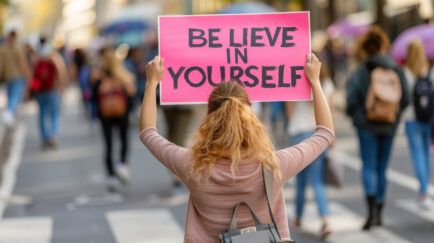
 The internet never forgets. It collects our photos, posts, searches, purchases, likes, and locations. Algorithms use our digital trail to predict what we might do next, what we’ll click on, what we’ll buy, even what we may believe. But while the internet can aggregate our past, it can only guess at our future, not control it. Some people are concerned about how much is known about them and how the data which are collected are being used to influence our behaviors and attitudes. Fortunately, we still have the ability and the responsibility to deliberately create the life we want.
The future isn’t predetermined by analytics or probability. It’s shaped by the choices we make today and tomorrow. Choosing a different future almost always requires change, the one thing many of us resist until the end of the year as we plan the future.
Change isn’t comfortable. We must examine the familiar patterns that define our lives including but not limited to our environment, our habits, our activities, our attitudes, our behaviors, and sometimes even our friends and family relationships. But if the life ahead of us is going to be meaningfully different from the one behind us, we cannot expect transformation without adjusting the variables that shape who we are and who we want to be.
Our environment is one of the strongest of those variables. We like to believe that willpower alone drives growth, but the places we live, the rooms we work in, the communities we engage with all act as subtle architects of behavior. A cluttered environment can reinforce cluttered thinking. A toxic workplace can normalize stress and cynicism. An uninspired setting can quietly drain energy. Even the content we stream and the news sources we follow can have a profound effect. Conversely, being in a space that encourages creativity, learning, or health can make personal change not only more likely, but more natural. Sometimes the first step toward a new future is as simple and profound as turning off your digital communication devices, changing the channel or listening to a new positive source, or choosing a different room, a different team, or a different city. The most difficult change of all is choosing to disassociate from the cynical or overly negative people who are influencing your thinking.
Our activities and habits form another layer of influence. The routines we repeat daily shape our trajectory, even when they feel small or inconsequential. Reading or scrolling. Walking or sitting. Connecting or withdrawing. Reflecting or reacting. Every habit casts a vote for the person we are becoming. If we want to design a more intentional future, one with greater purpose, fulfillment, or contribution, we must align our routines with that intention. Sustainable change rarely happens in dramatic leaps. It happens in quiet, consistent shifts.
Attitudes and behaviors sit even deeper, at the level of mindset and choice. The stories we tell ourselves, e.g., I’m too old to change, I’ve already made my path, I’m just not that kind of person, can quietly lock us into yesterday’s identity. The opposite is also true. Fortunately, optimism or the simple act of reframing possibility expands what we believe we’re capable of becoming. When we move from cynicism to optimism, fear to curiosity, from resentment to gratitude, from defensiveness to openness, the world presents new options that previously felt out of reach. Change often begins internally long before it becomes visible to anyone else.
Then there are relationships which are the most sensitive but significant variables of all. The people around us influence our sense of identity, possibility, and limits. Some relationships nourish growth. Others reinforce stagnation or self-doubt. Choosing a different future may sometimes require redefining boundaries, diversifying our circles, or surrounding ourselves with people who challenge, inspire, and support transformation. This doesn’t always mean leaving people behind but it does mean being honest about whether our connections pull us forward or hold us back.
None of this is easy. Changing environments, habits, attitudes, or relationships requires courage. It often means stepping into uncertainty, tolerating discomfort, and letting go of identities that once served us. But the alternative, i.e., allowing our future to be dictated by inertia or by other people’s expectations carries its own cost.
The most meaningful futures are not inherited and they are not predicted. They are designed. They emerge from intentional choices grounded in self-awareness, values, and purpose. They are built by people who are willing to ask hard questions. As you prepare for 2026, consider asking these questions. First, am I satisfied with the me of the present? Who am I becoming? Who do I want to become? What am I willing to change to move in that direction?
The internet may know our past, but it does not define our destiny. Each of us can rewrite our trajectory, not by erasing who we’ve been, but by deliberately choosing who we want to be next.
The future is not a forecast. It is a creation. And it begins with the courage to change.
As my mother was so fond of saying, “Have a Happy, Healthy, and Prosperous New Year!”